PRECISION TITANIUM LASER CUTTING FOR MEDICAL DEVICES: CUSTOM FIBER LASER SOLUTIONS WITH CCD VISION
October 16, 2026
Quick Answer: Can Fiber Lasers Cut Precision Titanium Medical Components?
Yes. Fiber laser cutting can be used to manufacture precision titanium components for medical devices, including certain craniomaxillofacial (CMF) fixation components, surgical hardware, and other specialized metal parts.
For complex components that have already undergone CNC machining, fiber laser cutting can serve as a secondary manufacturing process to complete intricate contours, openings, and part separation. CCD vision positioning can help align the cutting path with existing machined features.
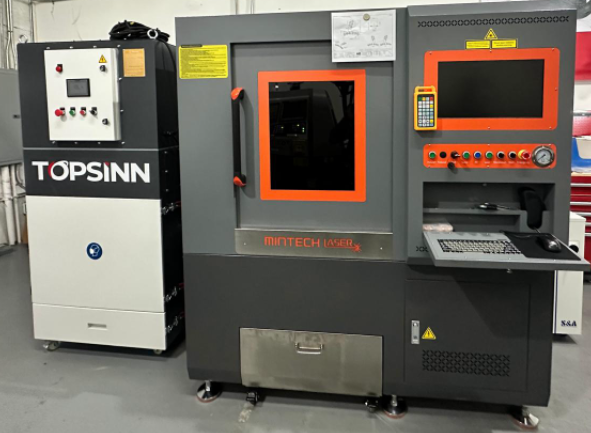
For one specialized medical manufacturing application, Mintech developed a customized 3 kW continuous-wave (CW) fiber laser cutting system for titanium ranging from 0.3 mm to 3.0 mm in thickness.
The system combines a compact 24″ × 24″ class working area, CCD vision positioning, a granite machine base, linear motor drives, and high-precision position feedback.
With specified positioning accuracy of ±0.01 mm and repeat positioning accuracy of ±0.005 mm, the machine is engineered for demanding precision-manufacturing workflows. Actual finished-part tolerances must be verified through application-specific processing and inspection.
The key advantage is not simply the machine's cutting power or small footprint. It is the ability to customize an industrial-grade system around the exact manufacturing requirements.
1. Why Is Titanium Used in Medical Device Manufacturing?
Titanium is widely used in medical device manufacturing because of its combination of corrosion resistance, biocompatibility, mechanical properties, and relatively low density.
Depending on the intended application, manufacturers may select commercially pure titanium or medical-grade titanium alloys.
Two widely recognized material specifications include:
ASTM F67 — Unalloyed Titanium for Surgical Implant Applications
Commercially pure titanium is used in various implantable medical components, including certain fixation plates and meshes.
ASTM F136 — Ti-6Al-4V ELI Titanium Alloy
This alloy is used for certain implantable devices requiring specific strength and mechanical characteristics.
Titanium is especially relevant in applications involving bone fixation, reconstruction, and surgical hardware.
However, titanium's material properties also create manufacturing challenges.
When parts contain extremely fine contours, closely spaced holes, narrow connecting sections, and intricate geometries, manufacturers must carefully control positioning, heat input, edge quality, and dimensional consistency.
These requirements make precision manufacturing technology particularly important.
2. Medical Application: Precision Titanium Components for Craniomaxillofacial Surgery
Craniomaxillofacial (CMF) surgery involves the bones and structures of the skull, face, and jaws.
Certain surgical procedures use titanium fixation plates, meshes, and other specialized components to support bone stabilization or reconstruction.
Examples of related applications include:
Zygomatic (cheekbone) fracture fixation
Orbital fracture reconstruction
Maxillary and mandibular fixation
Orthognathic surgery fixation systems
Cranial fixation and reconstruction components
Other specialized titanium surgical hardware
These components may incorporate complex profiles, multiple precisely located openings, narrow connecting sections, and carefully controlled geometries.
For manufacturers producing such parts, the challenge extends beyond simply cutting titanium sheet.
The manufacturing process must accommodate the component's geometry, previous machining operations, material requirements, and dimensional specifications.
In some cases, a combination of CNC machining and fiber laser cutting provides a practical manufacturing approach.
3. Why Combine CNC Machining and Fiber Laser Cutting?
CNC machining and fiber laser cutting offer different manufacturing capabilities.
CNC machining can create three-dimensional features such as recessed geometries, counterbores, surface profiles, and other mechanical details.
Fiber laser cutting uses a focused laser beam to perform suitable contour cutting and through-cutting operations without mechanical tool contact.
For a component requiring both machined geometry and intricate cutting, these technologies can complement each other.
A Typical Hybrid Manufacturing Workflow
Step 1 — CNC Pre-Machining
The titanium material undergoes the required CNC machining operations, creating specified holes, recesses, surfaces, or other mechanical features.
Step 2 — Workpiece Loading and Fixturing
The previously machined titanium workpiece is loaded onto the fiber laser cutting system and secured using an appropriate fixture.
Step 3 — CCD Vision Recognition
The vision system detects identifiable reference features and establishes the actual position and orientation of the workpiece.
Step 4 — Precision Fiber Laser Cutting
The laser performs the programmed contour-cutting or part-separation operations, aligned to the recognized features.
Step 5 — Inspection and Post-Processing
The finished components undergo the required dimensional inspection, edge finishing, cleaning, and other manufacturing procedures.
The exact operations and process sequence depend on the component design.
Rather than forcing every feature to be produced by a single technology, manufacturers can select the most appropriate process for each stage.
This approach is especially relevant when precision parts require secondary cutting after CNC machining.
4. Why Is CCD Vision Important for Laser Cutting Pre-Machined Titanium?
One of the most important challenges in secondary laser cutting is aligning the cutting path with features that already exist on the workpiece.
For example, a small titanium component may contain holes or machined features created during an earlier CNC operation.
When the part is transferred to another machine, its actual position may differ slightly from the programmed coordinate system.
For components with narrow connecting sections or closely spaced features, even small alignment differences can affect the finished geometry.
How CCD Vision Positioning Works
A CCD vision-assisted cutting system uses a camera to recognize identifiable features on the workpiece.
Depending on the configured software and application, these references may include machined holes, edges, or other detectable geometric features.
Mintech's customized system integrates automatic feature recognition and X/Y/θ deviation compensation.
This allows the control system to compensate for the workpiece's position and angular orientation during cutting alignment.
The benefits can include:
Reduced Manual Alignment
Vision-assisted recognition can reduce the need for repeated manual positioning and origin adjustment.
Alignment with Existing Features
The laser cutting path can be referenced to previously machined geometry.
Consistent Secondary Processing
The same positioning strategy can support repetitive processing of parts with suitable reference features.
Flexible Fixturing
Vision positioning can complement customized fixtures, helping manufacturers develop efficient loading and processing procedures.
CCD vision is not a substitute for machine precision, proper fixturing, or process validation.
Instead, it adds another layer of positioning capability to an already precise manufacturing system.
For small, intricate titanium components, this combination can be particularly valuable.
5. Small Working Area, Industrial-Grade Precision: Inside a Customized Fiber Laser System
In precision manufacturing, a larger cutting table is not always an advantage.
When processing small, high-value components, the priority may be precise motion, stable cutting conditions, accurate positioning, and effective integration with existing manufacturing operations.
For one specialized titanium medical component application, Mintech configured a compact fiber laser cutting system with a 24″ × 24″ class working area (approximately 600 × 600 mm).
Although the cutting area is relatively small, the system incorporates the power, motion components, structural rigidity, and positioning functions expected from industrial precision equipment.
Customized Machine Configuration
| Feature | Application-Specific Configuration |
|---|---|
| Laser source | 3,000W Continuous-Wave (CW) Fiber Laser |
| Working area | 24″ × 24″ class / approximately 600 × 600 mm |
| Titanium thickness | 0.3–3.0 mm |
| Vision system | CCD automatic feature recognition and X/Y/θ compensation |
| Machine base | Granite |
| X/Y drive system | Linear motors |
| Position feedback | Renishaw linear encoders |
| CNC control | BOCHU laser control with vision integration |
| Workholding | Pneumatic clamping |
| Positioning accuracy | ±0.01 mm |
| Repeat positioning accuracy | ±0.005 mm |
| Approximate machine weight | 1,000 kg / 2,205 lb |
| Manufacturing application | Precision cutting of CNC pre-machined titanium components |
This is one customized configuration developed for a particular application. It is not a fixed specification for every Mintech fiber laser system.
3 kW CW Fiber Laser: Industrial Cutting Capability in a Compact System
The customized machine uses a 3 kW continuous-wave fiber laser source.
The laser configuration was evaluated against titanium samples measuring 0.3 mm, 0.9 mm, and 3.0 mm in thickness.
A CW laser source was selected to provide the required power capacity across the full material thickness range.
For precision titanium processing, having sufficient available laser power does not mean operating at maximum power for every cut.
Actual cutting conditions must be adjusted according to thickness, geometry, heat input, edge requirements, and other process factors.
The 3 kW configuration allows the machine to address the specified range of thin titanium materials while providing the industrial power capacity needed for the application.
Granite Machine Base: Stability for Precision Cutting
One of the most distinctive features of this system is its granite machine base.
Granite is used in precision equipment because of its dimensional stability and favorable vibration-damping characteristics.
In a laser cutting machine, the foundation supports the motion system and helps maintain stable operating conditions.
For small titanium components with intricate features, structural stability is especially important.
A compact working area does not eliminate the need for rigid machine construction.
In fact, precision-oriented applications may justify a more substantial machine structure than their physical workpiece dimensions initially suggest.
Linear Motors and Renishaw Position Feedback
The system uses linear motors on the X and Y axes, together with Renishaw linear encoders.
Linear motors provide direct-drive motion without conventional mechanical transmission elements such as lead screws or rack-and-pinion drives on those axes.
The encoders provide precise position feedback to the motion-control system.
Together with the granite base and industrial CNC control, these components support high-precision machine positioning.
The system is specified with:
Positioning Accuracy: ±0.01 mm
Repeat Positioning Accuracy: ±0.005 mm
These specifications describe the machine's positioning capability.
They do not automatically establish a ±0.01 mm tolerance on every laser-cut component. Actual cutting accuracy also depends on laser kerf, material behavior, thermal effects, fixture stability, and process conditions.
For medical component manufacturing, final tolerances must be verified through appropriate dimensional inspection.
Small Cutting Table. Heavy-Duty Construction.
Despite its approximately 600 × 600 mm cutting area, the customized system has an approximate machine weight of 1,000 kg (2,205 lb).
This reflects an engineering approach that prioritizes structural rigidity and a stable precision platform rather than minimizing machine weight.
The compact work area is supported by a granite foundation, industrial motion components, high-precision position feedback, and controlled workholding.
For manufacturers handling small but demanding components, this combination can be more relevant than the ability to process large sheets.
Small workpieces can demand industrial-grade machine engineering.
6. Why Choose a 3 kW CW Laser Instead of a Lower-Power Configuration?
Medical and precision-manufacturing customers often process thin materials, but material thickness alone does not determine the ideal laser configuration.
One application may require delicate cutting of 0.3 mm titanium.
Another may involve the same component family in thicknesses approaching 3.0 mm.
The system must be evaluated across the complete thickness range.
For this project, titanium samples in three thicknesses—0.3 mm, 0.9 mm, and 3.0 mm—were tested using a 3 kW CW fiber laser.
Based on the application requirements and engineering evaluation, the CW configuration was preferred over the lower-average-power QCW alternative considered for this project.
The main consideration was maintaining adequate cutting capability across the full 0.3–3.0 mm titanium range.
This highlights an important principle:
The correct laser source is the one that meets the complete material and production requirements—not simply the lowest thickness listed on the drawing.
7. What Makes Precision Laser Cutting of Thin Titanium Challenging?
Titanium laser cutting requires careful attention to both dimensional accuracy and material condition.
For medical-related components, several factors become especially important.
Heat-Affected Zones
Laser cutting introduces localized thermal energy.
Depending on the cutting parameters, this can produce a heat-affected zone adjacent to the cut.
For critical components, the thermal effects must be evaluated against the material and part specifications.
Cutting Kerf
The laser beam removes material along the programmed path, creating a cut width known as the kerf.
For example, application testing documented a kerf of approximately 0.08–0.10 mm when cutting 0.3 mm titanium.
Kerf width can change with material thickness and cutting parameters.
This is one reason why accurate machine positioning and actual finished-part tolerance are not the same measurement.
Burrs and Recast Material
Thermal cutting may produce burrs, adhered material, or resolidified material near the edge.
The acceptability of these features depends on the part requirements and subsequent finishing processes.
Oxidation and Surface Condition
Titanium can react with oxygen at elevated temperatures.
Assist-gas selection, process settings, and gas quality influence the resulting surface condition.
Fine Features and Narrow Connecting Sections
Intricate components may contain closely spaced holes, delicate contours, and narrow metal sections.
Cutting sequence, heat accumulation, workholding, and material movement must be considered during process development.
These factors make sample testing and process verification essential.
8. Real Application: Secondary Laser Cutting of Precision Titanium Medical Components
A specialized manufacturing project illustrates the value of combining CNC machining, fiber laser cutting, and CCD vision positioning.
The application involved thin titanium components for medical-related manufacturing, with material thicknesses ranging from 0.3 mm to 3.0 mm.
The workpieces had already undergone CNC machining before being transferred to the laser cutting process.
The manufacturing challenge was not simply cutting titanium.
It was completing intricate cutting operations while maintaining the required relationship between the laser-cut profiles and existing machined features.
The Manufacturing Challenge
The application required:
Processing small, detailed titanium components
Accommodating multiple titanium thicknesses
Aligning laser cuts with pre-machined geometry
Supporting fine-feature and precision cutting
Providing a compact cutting area without compromising industrial machine capability
Mintech's Customized Solution
The selected configuration combined:
3 kW CW Fiber Laser
To provide cutting power capacity for the specified 0.3–3.0 mm titanium range.
CCD Vision Positioning
To recognize reference features and support alignment of laser cutting paths with the workpiece.
Granite Machine Base
To provide a rigid foundation for precision motion.
Linear Motors and Renishaw Encoders
To support precise and repeatable machine positioning.
Compact Working Area
To accommodate the component dimensions and application-specific fixturing without requiring an unnecessarily large cutting table.
Heavy-Duty Machine Construction
To provide a stable industrial platform despite the relatively small working area.
This application demonstrates that advanced manufacturing requirements are not always associated with large workpieces.
A small, intricate titanium component may require more specialized machine engineering than a much larger, less demanding part.
It also illustrates Mintech's ability to develop equipment configurations around real manufacturing challenges rather than relying exclusively on standard machine formats.
9. Why a Compact Precision Fiber Laser Can Be Better Than a Large-Format Machine
Large-format fiber laser systems are well suited to many sheet-metal cutting applications.
However, specialized precision manufacturers may have different priorities.
A medical device manufacturer processing small titanium parts may need:
A compact and accessible cutting area
Precise part positioning
Specialized workholding
Vision recognition of existing features
High-precision machine motion
Stable processing of thin materials
Integration with CNC machining and inspection workflows
A large cutting table does not automatically improve any of these requirements.
A purpose-built compact system can instead concentrate the machine configuration around the specific process.
The result is a machine designed for the application rather than a general-purpose platform with unnecessary working area.
For high-value precision components, this can be a practical approach to equipment customization.
10. Customizable Working Areas: One Application, Many Possible Configurations
The approximately 600 × 600 mm working area in this project represents one customer-specific solution.
Mintech's custom fiber laser systems are not limited to a single working area or standard machine size.
Depending on the application, machine dimensions and system configurations can be developed around different manufacturing requirements.
Customization considerations may include:
Working area and machine footprint
Laser power and source configuration
CCD vision positioning
Motion and feedback systems
Workholding and fixturing
Machine structure and base design
Material loading and handling
Production workflow integration
Some customers require a compact precision cutting platform.
Others need larger processing areas, different laser capacities, or additional automation features.
The appropriate configuration starts with the actual material, component size, required accuracy, and production process.
At Mintech, we don't simply scale machines down. We engineer them around the application.
11. What Quality Requirements Apply to Titanium Medical Components?
Precision machine specifications are only one part of medical device manufacturing.
A fiber laser cutter does not automatically produce implant-ready or regulatory-compliant parts.
Medical device manufacturers must establish appropriate quality and manufacturing procedures based on the intended device.
These may include:
Material Verification and Traceability
Confirming the titanium grade, source, and applicable material specifications.
Dimensional Inspection
Measuring critical features, hole positions, profiles, and finished-part dimensions.
Edge and Surface Evaluation
Assessing burrs, recast material, oxidation, contamination, and heat-affected regions.
Process Validation
Demonstrating that the manufacturing process can consistently achieve the required results.
Post-Processing and Cleaning
Applying controlled finishing, cleaning, and other procedures appropriate to the device.
Documentation and Quality Management
Maintaining records and procedures consistent with applicable medical device manufacturing requirements.
For U.S. medical device manufacturers, regulatory considerations may include FDA quality management requirements and applicable ISO 13485 procedures.
The suitability of any laser cutting process must be established for the specific medical device and intended use.
12. Beyond Medical Devices: Applications for Customized Precision Fiber Laser Systems
Although this application involves titanium components for medical manufacturing, the underlying engineering capabilities can be relevant to other industries.
Precision Metal Components
Small, intricate metal parts requiring detailed contours and controlled positioning.
Aerospace and Specialized Industrial Parts
Selected thin-metal components requiring application-specific cutting and inspection.
Electronics and Instrument Components
Small metal parts with fine features, provided the process meets applicable material and dimensional requirements.
CNC Pre-Machined Metal Parts
Components requiring secondary laser cutting aligned with existing machining features.
Medical Device Prototyping and OEM Manufacturing
Development-stage and production components requiring specialized machine configurations.
Each application requires its own engineering review, material testing, and process development.
13. How Mintech Approaches High-End Machine Customization
At Mintech, equipment customization begins with understanding the manufacturing problem.
For precision fiber laser cutting, we consider:
What material is being processed?
What is the thickness range?
How small or complex are the part features?
Has the workpiece already undergone CNC machining?
Does the process require CCD vision or other alignment functions?
What machine positioning specifications are required?
What working area and fixture arrangement are appropriate?
How will the manufacturer inspect and validate finished components?
The answers help determine the appropriate laser source, machine structure, motion system, vision capability, workholding, and working area.
For one customer, the result may be a compact 24″ × 24″ class precision fiber laser system with a heavy-duty granite base.
For another, it may be a larger customized platform with different processing and automation requirements.
High-end customization is not simply changing the machine dimensions. It means engineering the complete system around the production requirements.
Frequently Asked Questions
Can a fiber laser cut titanium used in medical devices?
Yes. Fiber lasers can process suitable titanium grades used in medical device manufacturing. However, the cutting process must be qualified or validated as appropriate for the actual component, material, and intended application.
Can a 3 kW fiber laser cut 0.3–3.0 mm titanium?
Yes. A properly configured 3 kW CW fiber laser can be used to process this thickness range. Actual cutting speed, edge quality, and dimensional results depend on material grade, geometry, assist gas, and process parameters.
Why use CCD vision for laser cutting pre-machined titanium?
CCD vision can recognize existing reference features and help align the programmed cutting path with the actual position and orientation of a previously machined component.
What is the benefit of a granite base on a precision laser cutting machine?
A granite base provides a rigid, dimensionally stable foundation with favorable vibration-damping characteristics. This can support precision motion and stable processing conditions.
Does a 24″ × 24″ working area mean the machine is only suitable for light-duty applications?
No. Working area and industrial capability are separate considerations. A compact machine can incorporate high laser power, precision motion components, heavy-duty construction, and advanced positioning functions.
What does ±0.01 mm positioning accuracy mean?
It refers to the machine's specified positioning capability, not a guaranteed ±0.01 mm cutting tolerance on every finished part. Actual part accuracy depends on the complete manufacturing process.
Why use a 3 kW CW laser for relatively thin titanium?
The required configuration must support the full material thickness range and cutting requirements. A 3 kW CW laser may provide useful power capacity for applications involving both thin and thicker titanium components, but actual process settings must be optimized.
Can a fiber laser cut titanium parts after CNC machining?
Yes. Fiber laser cutting can be used as a secondary manufacturing operation after CNC machining. Appropriate fixturing and vision-assisted alignment may help position the laser cutting path relative to existing features.
Can Mintech customize the fiber laser working area?
Yes. Mintech offers application-specific fiber laser system customization, including working area, laser power, vision positioning, motion components, and other machine functions.
What information is needed for a custom precision fiber laser cutting solution?
Useful information includes material type and grade, thickness, part dimensions, CAD drawings, existing machined features, required tolerances, production volume, and any special fixturing or positioning requirements.
Final Thoughts: Small Workpieces. Demanding Precision. Industrial-Grade Engineering.
Precision manufacturing is not defined by the size of the cutting table.
For medical device manufacturers, precision metal fabricators, and specialized OEM suppliers, even a small titanium component may require sophisticated machine engineering.
A customized compact fiber laser system can combine high laser power, CCD vision alignment, granite-base stability, direct-drive motion, precision feedback, and application-specific workholding in a focused industrial platform.
The result is more than a small laser cutting machine.
It is an engineered manufacturing solution designed around the component and process.
Have a precision titanium or metal component that requires a customized cutting solution?
Send Mintech your material specifications, thickness, CAD drawings, existing machined features, and production requirements.
Our team can help evaluate the appropriate laser cutting process, working area, vision positioning, and machine configuration.
Mintech CNC Solutions
Rooted in U.S., Serving the U.S.
Small Workpieces. Demanding Precision. Industrial-Grade Engineering.